Showing posts with label Math. Show all posts

Friday, July 12, 2019

Matrix Operations

Matrices appear with limited frequency on the ACT. (I have yet to see them used on the SAT.) There are a few things that you may be asked to understand about matrices - these are listed below.
  1. Adding/subtracting matrices
  2. Multiplying matrices
  3. Multiplying/dividing matrix elements by a constant or variable
  4. Finding the determinant of a matrix
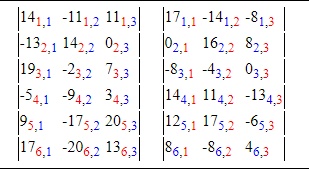
In order for a matrix addition/subtraction to take place, the matrices in question must have identical dimensions. This means that all matrices must have the same number of rows and the same number of columns. (The number of rows and columns do not have to match within a matrix.) We can add the two matrices below.


Each matrix has six rows and three columns, allowing them to be added/subtracted. When we add/subtract, we would add/subtract the entries in the corresponding locations, forming a new matrix of the same dimensions as the original two matrices. Multiplying matrices requires that the number of columns in the first matrix match the number of rows in the second matrix. Since the first matrix above has three columns and the second matrix has six rows, we cannot multiply the above matrices. We, however, can multiply the matrices below.


In order to perform the multiplication, we multiply each column in the second matrix by each row in the first matrix. Each such product of a column and a row produces a single number. (The first number, placed in the first row and the first column, would be -9*19 + -2*18 + 2*-19 = -245.  The second number, placed in the second row and first column, would be -9*-3 + -2*8 + 2*-5 = 1.)  The resulting product matrix will have the same number of rows as the first matrix and the same number of columns as the second matrix.  The product matrix above would have six rows and five columns.  The two matrices below cannot be multiplied (columns of the first do not match rows of the second), showing that matrix multiplication is not commutative.


When a single term appears outside of a matrix, you simply multiply all elements within the matrix by that value or term.

The determinant of a matrix determines whether the system defined by the matrix has a unique solution.  If the determinant is non-zero, there is a unique solution to the system.  In order for a matrix to have a determinant, it must be a square matrix - its number of rows must match its number of columns.  Both of the matrices below have determinants.


The determinant of the second matrix is 6*14 - 5*7 = 84 - 35 = 49.  The determinant of the first matrix is 13*(-2)*(-6) + 10*12*(-3) + (-6)*16*12 - (-6)*(-2)*(-3) - 10*16*(-6) - 13*12*12 = 156 + -360 + -1152 - -36 - -960 - 1872 = 156 - 360 - 1152 + 36 + 960 - 1872 = -2232.  A full explanation for how to calculate determinants for larger matrices is beyond what you will need to know for the ACT/SAT.

Sunday, July 7, 2019

Revisiting Function Equality

Let us revisit function equality. Consider the simple scenario described below.
  • If f(x) = 5x and g(x) = ax, and if f(x) = g(x) for all values of x, then what is the value of a?
This may seem like a trivial example, but it applies to problems of the same general type. So, let us look at the following table.

xf(x)g(x)a
-5-25-5a5
-4-20-4a5
-3-15-3a5
-2-10-2a5
-1-5-a5
000anything
15a5
2102a5
3153a5
4204a5
5255a5

Only when x = 0 will a take on any value other than 5, but since the two functions must be equal for all values of x, a must be 5. This idea can be expanded to more complicated problems. Let us look at another example.
  • If (a + 7)(x2 + 3x - 4) = (2x + b)(2x + 8) for all values of x, then what is the value of b?
There are at least two ways to solve this problem. One of them, the one that you are likely to default to, will take much longer than the other. The longer, brute force method has you applying the Distributive Property to both sides and getting the following.
  • ax2 + 7x2 + 3ax + 21x - 4a - 28 = 4x2 + 16x + 2bx + 8b
Now, we can collect like terms.
  • (a + 7)x2 + (3a + 21)x - 4(a + 7) = 4x2 + (2b + 16)x + 8b
From the previous example, it should be evident that these two expressions will only be equal if the corresponding coefficients are equal.
  • (a + 7)x2 = 4x2 → a + 7 = 4
  • (3a + 21)x = (2b + 16)x → 3a + 21 = 2b + 16
  • -4(a + 7) = 8b
From the first of these three equations, we can see that a = -3. We can then use this value in either of the other equations to conclude that b = -2. However, this can be solved with far less work by analyzing the equation more closely early on. Let us rewrite the problem.
  • If (a + 7)(x2 + 3x - 4) = (2x + b)(2x + 8) for all values of x, then what is the value of b?
If we look at the right side of the equation, we can clearly see that the x2 term will be 4x2. This then forces the x2 term on the left to also be 4x2, forcing a + 7 = 4. If a + 7 = 4, then the constant term on the left hand side will have to equal -16, forcing the constant term on the right hand side, 8b, to also equal -16. If 8b = -16, b = -2.

We get to the same answer with either method, but if you practice the second of the two methods, you can become more proficient at getting to the answer faster.

Monday, July 1, 2019

What is a Function?

A function is a set of instructions that you perform on an input or on multiple inputs in order to produce an output. Whenever you are given a function, you should identify what the input is (inputs are) and figure out what instructions you are being asked to perform on that input (those inputs). It is important that you not get hung up on what specific variable is being used (or variables are being used); the more important thing to do is to understand what instructions/operations are being asked to be performed on the input(s). Let's take a look at an example. What is the difference between the following two functions?
  • f(x) = x2 + 3x
  • f(y) = y2 + 3y
The answer is that there is no difference between these two functions. In each case, we have a single input and have these instructions.
  1. Square your input
  2. Add three times your input
The fact that we use a different variable in the two cases is irrelevant. Each function has the same number of inputs, and we perform the same instructions on those inputs. The functions are thus equivalent. Let's look at another example.
  • If f(x) = -x2 + x + 17, then what is f(x - 2)?
Here are our instructions.
  1. Take the negative of the square of your input
  2. Add your input
  3. Add 17
We are asked to find f(x - 2); our input has changed, but our instructions have not.
  • f(x - 2) = -(x - 2)2 + (x - 2) + 17
  • f(x - 2) = -(x2 - 4x + 4) + x - 2 + 17
  • f(x - 2) = -x2 + 4x - 4 + x + 15
  • f(x - 2) = -x2 + 5x + 11
Let's look at one more example. It's similar but a bit trickier.
  • If f(x - 3) = x2 + 3, then what is f(x)?
In this case, our input is x - 3, but we want to turn our input into just x. This may seem complicated, but it really is not. All we have to do is to substitute x + 3 everywhere that we see x. Let's do it.
  • f((x + 3) - 3) = (x + 3)2 + 3
  • f(x + 3 - 3) = (x2 + 6x + 9) + 3
  • f(x) = x2 + 6x + 12
Here are a couple of extra problems for you to try if you so please.

Example Problems

If f(x) = 2x2 + 4x - 2, then what is f(x - 3)?
If f(x + 5) = x2 + 14x + 53, then what is f(x)?

Wednesday, June 26, 2019

Equations - Things Must be of the Same Type

The following two rules are extremely important, and you may have heard me state them on many occasions.
  1. Only things of the same type can be added/subtracted.
  2. Only things of the same type can be set equal.
Almost without fail in word problems, units of measure will be attached to various values and variables. In order to appropriately create the equations that are suggested by these word problems, you must be able to attach the appropriate units to each variable/value in the question. Then, keeping in mind the two rules listed above, you should be able to put together the equations correctly. Let's look at the following example and appropriately attach units.
  • On a certain day at a furniture store, a total of 149 dressers and tables were sold. If dressers cost $21 each, tables cost $12 each, and a total of $3066 was collected on that day, then how many tables were sold?
Let's establish variables and attach appropriate units.
  • Let x = the number of dressers
  • Let y = the number of tables
  • $21dresser
  • $12table
  • 149 pieces of furniture
  • $3066
Now, let's set up the equations.
  • x dressers + y tables = 149 pieces of furniture
  • $21dresser*(x dressers) + $12table*(y tables) = $3066
In the first equation above, we are allowed to add the number of dressers to the number of tables because they are both of the same type: pieces of furniture. We can thus set this sum equal to the number of pieces of furniture. In the second equation, by performing the multiplications shown on the left side, we convert each product into something of type $, which is identical to the type on the right hand side of the equation. Using dimensional analysis, we can simplify the second equation to the following.
  • $21dresser*(x dressers) + $12table*(y tables) = $3066
We can now drop the struck-through units and simply the equation.
  • $21x + $12y = $3066
From here, it is a simple task to solve this via elimination. If you need a refresher on this process, look here.

Thursday, June 6, 2019

Sequences

General Information

You will occasionally be given problems that ask you to identify terms in a particular sequence. You will need to understand in particular how Arithmetic Sequences and Geometric Sequences. (There are of course other sequences that you will encounter, but these will have rules that are given to you at the time the sequences are introduced.)

Arithmetic Sequences

Arithmetic Sequences are sequences in which you add the same value (called the common difference) to get from one term to the next. As a result, between any two consecutive terms in an arithmetic sequence, the difference/gap will be the same. Below are two different equations for finding any term in an arithmetic sequence, where n is the sequence term number, an is the nth term in the sequence, and d is the common difference.
  • an = a1 + d(n - 1)
  • an = a0 + dn
Though you will often see the first of these equations used to define an arithmetic sequence, both of them technically work. The zeroth term does not actually exist, but if you go backwards to what would have been the zeroth term, the second equation is much simpler and resembles the slope-intercept form of a line. (The common difference is the slope, and the zeroth term is the y-intercept.) Though arithmetic sequences are simple sequence types, they are sometimes easy to miss. Below are a few examples of arithmetic sequences, with the common difference in parentheses.
  • 1, 2, 3, 4, 5, 6, 7, ... (1)
  • 10, 9, 8, 7, 6, 5, ... (-1)
  • 12, 1, 32, 2, 52, 3, 72, 4, ... (12)
  • 29, 29, 29, 29, 29, 29, 29, ... (0)
There are two short-cut features that you will want to remember about arithmetic sequences. The first is that the mean and median of an arithmetic sequence are always identical. This feature of the arithmetic sequence is due to the symmetry of sequence caused by the common difference. This first short-cut then leads to the second short-cut: if you can identify the mean/median of an arithmetic sequence, you can find the sum of those terms by multiplying that mean/median by the number of terms in the sequence. Let's look at the sequences listed above.
  • 1, 2, 3, 4, 5, 6, 7 - mean/median = 4 - sum = 7*4 = 28
  • 10, 9, 8, 7, 6, 5 - mean/median = 7.5 - sum = 6*7.5 = 45
  • 12, 1, 32, 2, 52, 3, 72, 4 - mean/median = 94 = 2.25 - sum = 8*2.25 = 18
  • 29, 29, 29, 29, 29, 29, 29 - mean/median = 29 - 7*29 = 203

Geometric Sequences

Geometric Sequences are sequences in which you multiply the same value (called the common ratio) to get from one term to the next. As a result, if you divide any term in the sequence by the previous term in the sequence, the value will always be the same. Below are two different equations for finding any term in a geometric sequence, where n is the sequence term number, an is the nth term in the sequence, and r is the common ratio. Of note concerning geometric sequences is that they can alternate positive to negative and negative to positive. Arithmetic sequences can only go in one direction.
  • an = a1rn - 1
  • an = a0rn
As with the arithmetic sequence, the geometric sequence formula that will generally be given to you is the first of the two listed. However, even though the zeroth term does not technically exist, a phantom zeroth term can be calculated and used to make this formula simpler. Below are a few examples of geometric sequences, with common ratios in parentheses.
  • 1, 2, 4, 8, 16, 32, ... (2)
  • 32, 16, 8, 4, 2, 1, ... (12)
  • 1, -2, 4, -8, 16, -32, ... (-2)
  • 32, -16, 8, -4, 2, -1, ... (-12)
  • 29, 29, 29, 29, 29, 29, 29, ... (1)
The main feature about geometric sequences to remember is that the sum of an infinite geometric sequence can be calculated if |r| < 1. This sum is calculate by using the equation a11 - r. An infinite geometric sequence will not have a finite sum if |r| is not less than 1.

Sunday, June 2, 2019

The Unit Circle

The Unit Circle

The unit circle is a staple of high school math. It is very easy to learn because of patterns involved. You should spend the time learning it and not just for when you are tested on it in school.

Cosine Values

DegreesRadiansCosineNumerator
01√4
30°π6√32√3
45°π4√22√2
60°π312√1
90°π20√0
120°3-12-√1
135°4-√22-√2
150°6-√32-√3
180°π-1-√4
210°6-√32-√3
225°4-√22-√2
240°3-12-√1
270°20√0
300°312√1
315°4√22√2
330°11π6√32√3
360°1√4

If you pay close attention, you will see that there is a definite pattern. The numerator values for the cosines are clear square root countdowns of 4, 3, 2, 1, 0, -1, -2, -3, -4 (with the square root symbols omitted) before counting back up to 4. Every time there is radian denominator of 2, the cosine is 0. Every time there is a radian denominator of 3, the cosine is ±12. Every time there is a radian denominator of 4, the cosine is ±√22. Every time there is a radian denominator of 6, the cosine is ±√32.

Sine Values

DegreesRadiansSineNumerator
00√0
30°π612√1
45°π4√22√2
60°π3√32√3
90°π21√4
120°3√32√3
135°4√22√2
150°612√1
180°π0√0
210°6-12-√1
225°4-√22-√2
240°3-√32-√3
270°2-1-√4
300°3-√32-√3
315°4-√22-√2
330°11π6-12-√1
360°0√0

There is, of course, a pattern for the sine values as well. I will leave it to you to discover this pattern for yourself.

Linear Systems

General Information


Linear systems appear in many forms on the ACT and SAT (among other standardized tests, in various school subjects, and in life in general). Lines, as a reminder, have a constant slope and go on forever in both (opposite) directions. In a plane, two unique points will entirely define a line.

Below are listed the major linear forms that you will encounter.
  • Slope-Intercept Form: y = mx + b, where m is the slope and b is the y-intercept
  • Standard Form: Ax + By = C, where A, B, and C are all constants
  • Point-Slope Form: y - y1 = m(x - x1), where m is the slope found by calculating the slope between two points, (x1, y1) and (x2, y2), and you can use either of these two points as the point (x1, y1) in the equation
Given two lines in the xy-plane, there are only three ways in which they can interact.
  • The lines can intersect once.
  • The lines do not intersect. (They are parallel, have the same slope.)
  • The lines intersect an infinite number of times. (The system has infinite solutions because the lines are the same line.)
Very often, you will be asked to find a solution to a linear system (if that solution exists). If two lines have the same slope but different y-intercepts, the lines are parallel, and the system has no solution. If the lines do not have the same slope, they will intersect; there will be one solution. If the lines have the same slope and the same y-intercept, they will be the same line.

Solving Systems

Substitution

Perhaps the most popular method of solving a linear system is performing a substitution. In a substitution, you find an expression for one of the two variables in one of the two equations, and you plug this expression in for that variable in the other equation. By doing this, the equation is now in terms of one variable.

Let's look at the following example. Find the intersection point of the following linear system.
  • y = 2x + 7
  • y = -3x - 8
This type of linear system is conveniently set up to perform a substitution. Because these lines have different slopes, there will be a unique point, (x, y), that both lines share. Clearly, at that point, the x coordinate of each line will be identical, and the y coordinate of each line will be identical. We substitute by setting the two expressions containing the x variable equal to each other.
  • 2x + 7 = -3x - 8
We add 3x to and subtract 7 from both sides.
  • 5x = -15
We divide both sides by 5.
  • x = -3
We can technically substitute this value for x in either of the original equations to find y, but here we will substitute into both equations.
  • y = 2(-3) + 7 = 1
  • y = -3(-3) - 8 = 1
Our intersection point is (-3, 1).

Elimination

Elimination is generally performed when an intersection point is sought for two lines given in Standard Form. We eliminate one of the variables by multiplying one or both equations by a constant or constants in such a way that one variable expression is eliminated when the resulting lines are added.
  • 2x + 5y = 40
  • -3x + 6y = 21
We can perform the elimination by either multiplying the top equation by 3 and the bottom equation by 2 (eliminates the x variable) or multiplying the top equation by 6 and the bottom equation by -5 (eliminates the y variable). There are of course other options that we can use. Here we will multiply the equations by 3 and 2.
  • 3(2x + 5y) = 3(40)
  • 2(-3x + 6y) = 2(21)
After performing the multiplications we have the following.
  • 6x + 15y = 120
  • -6x + 12y = 42
Now, we add the two equations and get the following.
  • 27y = 162
We now divide by 27 and find y.
  • y = 6
We can substitute this value of y back into any of the equations, but we will use both of the original equations to prove that the intersection point is identical for each.
  • 2x + 5(6) = 40
  • -3x + 6(6) = 21
Next...
  • 2x + 30 = 40
  • -3x + 36 = 21
Next...
  • 2x = 10
  • -3x = -15
Finally...
  • x = 5
  • x = 5
Our intersection point is (5, 6).

Linear System Shortcuts

There are a number of shortcuts that you can use to solve questions involving lines quickly. Below is a list of a few of these shortcuts, and it will grow longer as I think of more.
  1. The points (5, -16) and (-2, -9) lie on the same line. Because the sum of the x and y coordinates for both points is -11, the equation for this line is x + y = -11. Whenever you find two points on a line whose coordinates sum to the same value, the equation of that line in Standard Form is x + y = sum. The coordinates of every point on this line must have this sum.
  2. Given a linear system in Standard Form (like the one below), if A1A2 = B1B2, then the lines have the same slope and are at least parallel. If A1A2 = B1B2 = C1C2, the lines are the same line.
    • A1x + B1y = C1
    • A2x + B2y = C2
    This works because all of the slope information lies on the left side of the equation when a line is in Standard Form.
  3. Given a linear system in Standard Form (like the one below), if A1B1 = -B2A2, then the lines are perpendicular.
    • A1x + B1y = C1
    • A2x + B2y = C2
    Again, this works because all of the slope information lies on the left side of the equation when a line is in Standard Form. Thus, all we need to show is that these coefficients have a negative reciprocal relationship to show that the lines are perpendicular.

Example Problems

  1. If line m, going through points (-3, 8) and (7, -2), intersects line n, having slope 2 and going through point (3, 2), at the point (a, b), then what is a + b?

  2. Show that the following system has no solution.
    • 2x + 3y = 8
    • x + 32y = 6

  3. Show that the following system has an infinite number of solutions.
    • 5x + 4y = 8
    • 3x + 125y = 4.8

  4. Show that the following lines intersect perpendicularly.
    • 5x + 4y = 8
    • -8x + 10y = 9